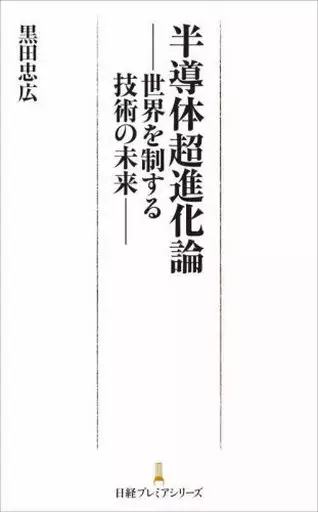
Semiconductor Superevolution : Tadahiro Kuroda


Product description ※Please note that product information is not in full comprehensive meaning because of the machine translation.
SOCIETY
The world market share of Japanese companies is now 10 percent, compared with 50 percent in 1988. In the past 30 years, the world market share of semiconductors has continued to grow at an annual rate of more than 5 percent. In contrast, the Japanese market share has not grown at all. At this rate, the "Japanese market share is almost 0 percent?" may be asked. On the other hand, the world market is growing at an annual rate of 8 percent thanks to the tailwind of the digital revolution. In 2030, the market share is expected to exceed 100 trillion yen, double the current level. Is there a reversal scenario? / The essence of strategies for semiconductors is, in a word, aggressive investment in miniaturization technology. However, it is difficult to regain the lost 30 years with just a fixed foundation. It is also necessary to make upfront investment by anticipating the second act of competition. It is also called "shooting ahead of the future" in kendo. In order to understand the current complex situation, it is necessary to understand the three types of changes that produce chips : (1) change of industry leading role, (2) market wave, and (3) paradigm shift of technology. / These changes make chip design as easy as writing software code. If so, the world will be revolutionized. If not only a few large TSMC customers like Apple and Tesla can make chips, but also many people can make chips. It means to increase the number of people who can utilize semiconductor technology by one or two orders of magnitude. This is the "democratization of semiconductors," which is the subject of this book, and there is a chance for Japan to reverse itself. The current situation in which the population of hardware designers is much smaller than that of software developers will be changed in one stroke and new forms of innovation will bloom. / The key person who leads strategies for semiconductors, Professor Tadahiro Kuroda of the University of Tokyo is the first book for the general public that clarifies the new world of semiconductors, the rapidly changing environment, and measures to cope with it. Beyond the framework of industry, government and academia, this book will be a must-read book for anyone involved in semiconductors. This is the first book for anyone involved in semiconductors. This is the first book for anyone involved in semiconductors. This is the first book for anyone involved in semiconductors. This is the first book for anyone involved in semiconductors. This is the first book