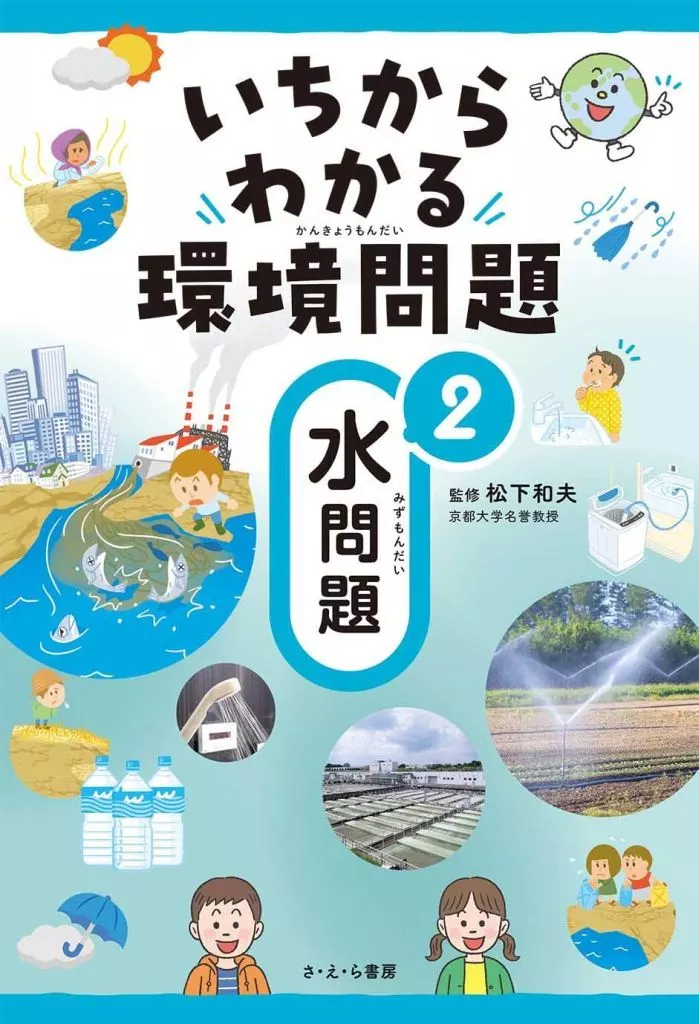
Children's book Water issues / Kazuo Matsushita


Product description ※Please note that product information is not in full comprehensive meaning because of the machine translation.
Children's Books
[Introduction to the Contents]
If you learn from the first thing, you will understand!
If you learn from the first thing, you will understand well!
It is often seen in the news, and you know something about it, but you don't really understand it.
It is not a matter of course that clean water is always easily available at home.
『 (2) Water Issues 』 explains water-related problems with a focus on the world's water shortages, water pollution, and the fact that some people don't have access to safe water.
In Japan, there is a lot of clean water coming out of the tap water at any time, but one out of four people around the world doesn't have access to safe water.
Table of Contents
Why is there not enough water? Why is there not enough water? What is the impact of climate change? How can we increase the amount of water available?
(3) Can't increase the amount of water on the earth?
(4) People use water for drinking water?
(7) Where and how much water is available in the world?
(7) People use water for drinking water?
(6) Where and how much water is available Professor Emeritus, Kyoto University ; Senior Fellow, Institute for Global Environmental Strategies (IGES).
Senior Fellow, Environment Agency, OECD Environment Bureau, Senior Environmental Planning Officer at the United Nations Earth Summit, and Professor at Kyoto University Graduate School of Global Environmental Studies (Global Environmental Policy Theory).
Has been a pioneer in the planning and research of global environmental policies, actively making proposals on climate change policies and SDGs.
Has researched sustainable development, environmental governance, climate change policies, biodiversity policies, and regional environmental policies.
His major books include "Climate Crisis at 1.5 ° C" (2022, Institute for Advanced Research in Culture and Science, Publisher), "Environmental Policy Studies" (2007, Maruzen Co., Ltd.), and "Environmental Governance" (2002, Iwanami Shoten).