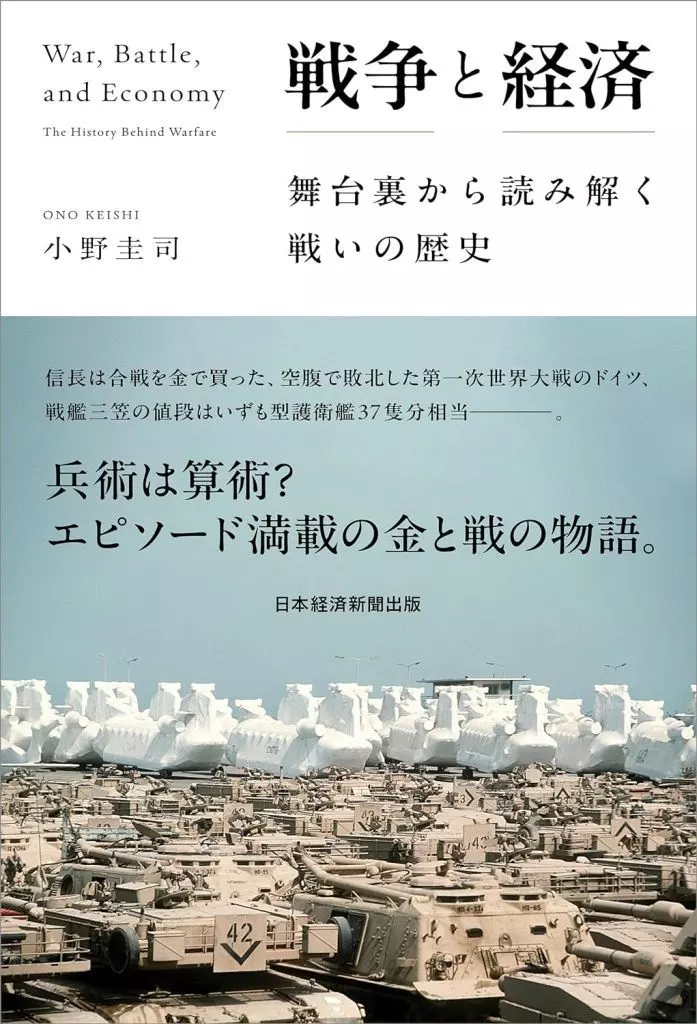
Economy War and Economics / Keiji Ono


Product description ※Please note that product information is not in full comprehensive meaning because of the machine translation.
Economy
[Contents]
The war expenditure of the Sino-Japanese War is 7% of GDP, the Russo-Japanese War is 22%, the Pacific War is 45%, and the outstanding amount of government bonds issued as of 2020 is 237.6%!
The price of the Battleship Mikasa is 4.4% of the general account expenditure at that time.
If you apply it to today's budget, it is equivalent to 28 Aegis ships.
It was in 1970 that the Russo-Japanese War's foreign bonds were repaid, and it was in 1985 that the Russo-Japanese War's debt was repaid without burden due to high post-war inflation and economic growth.
By the way, it was in 2010 that the Germans paid reparations for the First World War.
War and the economy are inseparable.
War and the economy are inseparable.
You cannot understand the war without understanding the economy.
Until winning : Macroeconomics of War
0 Renovation of Public and Private Life
0 Burden of Military Expenditure
0 War and Tax Increases
0 Distorted finance
0 Ending the War with 0 Economic Blockade and Arms Trade
0 Total War and Commerce and Trade
0 New Trends
Chapter 8 : Mercenaries Do Not Disappear : Public Economics of War
0 Oldest Occupation
0 From Mercenaries to Private Military and Security Companies (PMSCs)
○ Economic Thinking of War :
0 Total War Thinking and Economics
0 Marx
Economics and War
0 Military State and welfare state
0 Military Keynesism
0 Military-Industrial Complex Theory
[Author's brief history]
Special Researcher, Institute for Defense Studies
Graduated from the Faculty of Economics, Kyoto University in 1988, joined Sumitomo Bank in 1988-1996, joined National Institute for Defense Studies in 1997, completed the Master's Program (Social Studies Program), Graduate School of Aoyama Gakuin University in 1997, completed the Master's Program (Development Economics), Graduate School of London University (SO 0 0 0 0 0 0 0 0 0 0 0 0 2000 0 0 0 Reimei microeconomics Gavel